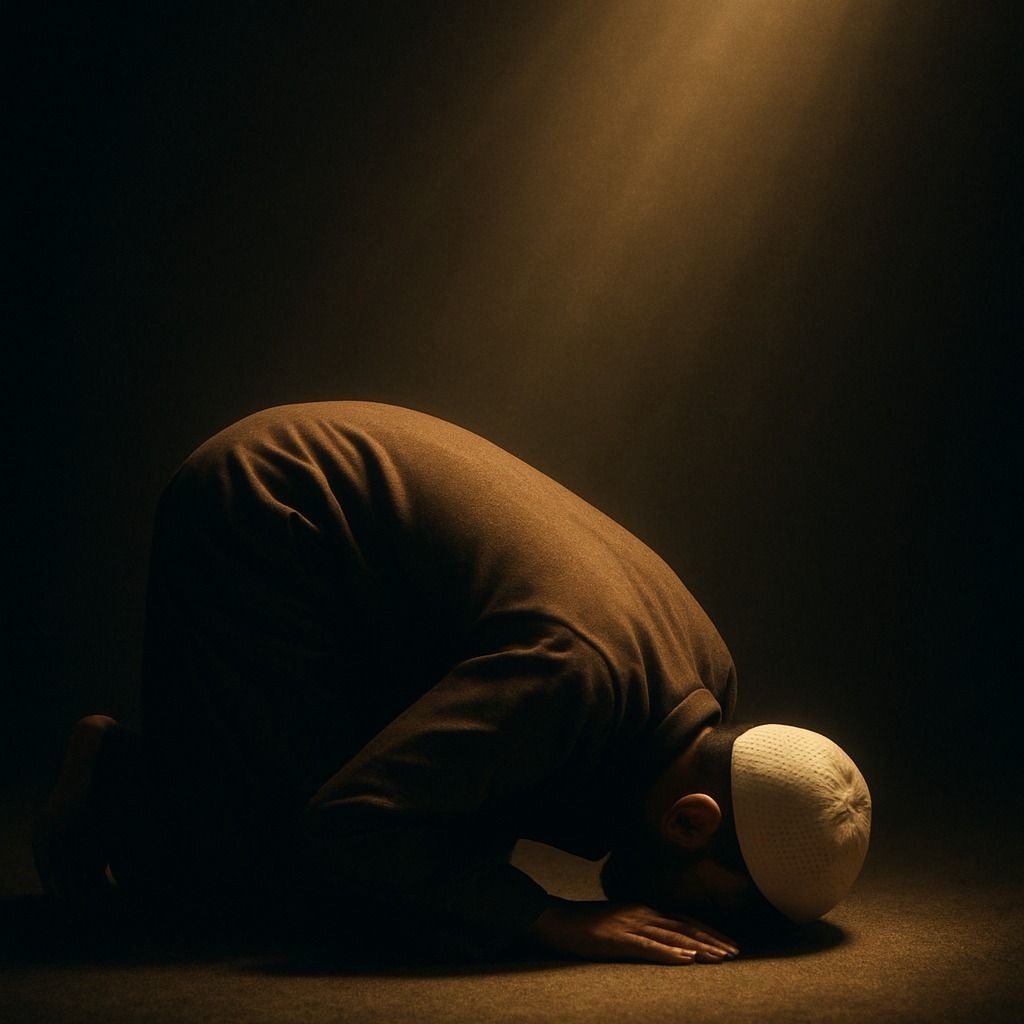
If you follow me on Instagram, you might remember a post I once shared explaining how to perform Sajdah Sahw. It became one of my most reshared and saved posts, and I received a few follow-up questions afterward, questions I couldn’t fully answer, as I am not an expert in fiqh.
Not long after posting it, however, I realised an error and that there was not enough clarity on some parts of the information I provided and it could be easily misinterpreted. So I made the decision to archive the post because I did not want to spread incorrect information. May Allah forgive me for all of my shortcomings and mistakes.
This blog post is my attempt to correct that error and to clearly present the correct position according to the Maliki school of jurisprudence, which is widely adopted and followed in Nigeria. I am deeply grateful to Imam Jibreel Jokomba, who graciously took the time to explain, clarify, and vet the information in this post. I learned a great deal through this process, and I firmly believe that knowledge should never be withheld, we never know who may be in need of it.
Our salah is one of the pillars of Islam and the first thing we will be judged on, on the day of judgement. Each of us are tasked with the responsibility of seeking knowledge, learning and unlearning, correcting and perfecting our salah as best as we can, even though we know we can never worship Allah perfectly.
What is Sajdah Sahw?
Sajdah Sahw literally means the prostration of forgetfulness. It is a mercy from Allah that allows us to correct certain mistakes made during salah.
Alhamdulillah for Allah’s compassion that our prayers are not instantly nullified because we forgot something or made a mistake. Instead, Allah gave us a way to amend our worship. That said, Sajdah Sahw is not performed in one single way; how it is done depends on what kind of mistake occurred in the salah.
While observing your salah if you ever thought:
“Wait… did I just do four raka‘at or three?” or “Astaghfirullah, did I just go into sujood without ruku?”
Welcome. You’re human and you’re not alone.
For the longest time, mistakes in salah used to make me panic. My heart would race, my thoughts would spiral, and sometimes I felt tempted to abandon the prayer entirely and start all over again out of fear of “doing it wrong.”
But Islam is not built on anxiety.
Allah is Ar-Rahman, and He gave us Sajdah Sahw as a form of mercy.
In this post, we’ll go through this step by step, slowly and practically, so that it’s easy to understand and apply immediately bi’ithnillah.
Foundations of Salah
Before we discuss sajdah sahw, I think it’s important to understand the following first:
- What actions are pillars (arkan) of the prayer
- What actions are wajib
- What actions are sunnah
- What nullifies the prayer completely
This foundation will help everything else make sense In Sha Allah.
The Arkan (Pillars) of Salah
These actions determine the validity of the prayer. Kindly take note that if any pillar is mistakenly or deliberately omitted, the rak‘ah becomes void.
The pillars of salah are:
- Takbiratul Ihram (the opening Allahu Akbar signifying entering a sacred state, prohibiting worldly actions and marking the beginning of worship)
- Recitation of Surah al-Fatihah
- Going into ruku
- Standing upright after ruku
- Performing the first and second sujood
- Sitting between the two sujoods
- The final tashahhud (Attahiyat). The first tashahhud is not a pillar but forgetting it still requires Sajdah Sahw (we’ll get to that).
- Tasleem (ending the prayer)
Wajib Acts of Salah
These are actions that are obligatory, but not pillars of salah they include:
- Moving the lips during recitation
- Saying Subhana Rabbiyal-‘Azim in ruku
- Saying Subhana Rabbiyal-A‘la in sujood
- The first tashahhud (Attahiyat)
Forgetting a wajib act does not invalidate the rak‘ah, but it does require Sajdah Sahw.
Sunnah Acts of Salat
These actions bring additional reward but do not affect validity if omitted.
They include:
- Placing the hands on the chest
- Reciting an additional surah after al-Fatihah
- Reciting aloud where applicable (i.e during Fajr, Maghreb and Isha Prayer)
Nullifiers of Salah
These actions invalidate the prayer entirely, and Sajdah Sahw cannot correct them:
- Breaking wudhu (passing wind/farting)
- A woman exposing the feet or other parts that must be covered during prayer (all parts of the female body except the face and palms should be covered when observing salah). For the men the navel and knee must be properly covered.
- Excessive movement in the salah
- Laughing aloud in salah (smiling does not invalidate the salah)
- Speaking in the salah
- Turning away from the qiblah
- If you turn away from the qibla with your eyeball (it doesn’t invalidate the prayer)
- If you turn away from the qibla with your neck (it doesn’t invalidate the prayer)
- If you turn away from the qibla with your entire chest (it invalidates the salah). There are exceptions, such as moving a child away from harm or praying in a moving vehicle such as a ship at sea or in the desert and not knowing the direction of the qiblah.
The following acts will instantly negate your salah and will require you to perform the prayer again. Kindly note that sajdah sahw cannot correct this.
Now that we are clear on the foundations of salah and what nullifies the prayer, let’s get to the crux of the issue and address the subject of today’s post.
There are Three Things That Can Happen in Salah
There are three main situations that may require Sajdah Sahw:
- Ziyadah (Addition): when you add something extra to the prayer.
- Naqs (Omission/Subtraction): when you omit or leave out a Wajib act.
- Shakk (Doubt): when you’re uncertain about something in the salah.
Each one has its own ruling, and once you understand them, salah becomes less stressful and more grounded.
1. Ziyadah (Addition): When You Add Something Extra to the Salah
This happens when you add an action to the prayer by mistake and you are certain that you did so.
Examples of this in practice are:
- Performing ruku twice
- Adding an extra rak‘ah to the salah
- Omiting a pillar/ruknu of salah and having to make it up. A quick example of this is when you go straight to sujood without doing rukoo (after you finished reciting fatiha and a verse of the quran). In this case that rakat is void because you missed a ruknu/pillar of the salah. You will have to pay back that rak’ah inside the salah.
In any of the above situation, Sajdah Sahw Ba’di is required at the end of the salah.
How to Perform Ba’di:
- You will complete your salah as normal.
- After finishing the final tashahhud (attahiyat), you will say tasleem (salam)
- Perform two sujoods
- Then say tasleem (salam) again.
- Note: no need to repeat tashahhud again.
Let’s Dive Deeper into a Common Scenario (Where a pillar of salah is omitted (see point 3 under this section above)
Let’s say you’re praying Asr.
You recite al-Fatihah and another surah from the Quran…then you go straight into sujood, forgetting ruku (a pillar of salah). While in sujood you realize your mistake and that you omitted or forgot to perform rukoo.
Here’s how Sajdah Sahw Ba’di will play out: after realizing the mistake you do not panic. You will continue praying as normal. You do not stop the prayer mid-way and restart the salah. What you will do is continue to the second rak’ah and this second rak’ah will now become and count as your first rak’ah because the first rak’ah you just finished praying is void because a pillar was missing. In this ‘second’ rak’ah which now counts as your first, you will not sit down for tashahhud because it is now the first rak’ah. Understood?
However, what happens if you do not immediately realise the mistake in the first rak‘ah?
Let’s return to our earlier example of praying Asr. In the first rak‘ah, you forgot to go into ruku and went straight into sujood, but you did not remember this mistake immediately. Instead, you only realised it later for example, during your third rak‘ah.
In this situation, the first rak‘ah remains void because a pillar (ruku) was omitted. The rak‘ah you are in at the moment you remember the mistake (in this case, the third rak‘ah) will now be recounted as your second rak‘ah.
What this means in practice is:
- At that point in your third rak’ah, you will sit for tashahhud, because it is now counted as the second rak‘ah, not the third. Don’t mind that you already sat down for tashahhud in the previous rak’ah.
- You then stand to pray what will now be your correct third rak‘ah (in reality, the fourth action unit), followed by your correct fourth rak‘ah (in reality, the fifth action unit).
- At the end of the prayer, you will sit for the final tashahhud (which occurs in the fifth rak‘ah outwardly, but counts as the fourth). This makes it a total of three tashahhud you’ve done in the prayer.
- Finally, after completing the prayer and making tasleem, you will perform Sajdah Sahw Ba‘di.
To summarize the key principle:
The point at which you remember the mistake is very important.
If you remember early, the next rak‘ah simply becomes your first rak‘ah and you disregard the first rak’ah.
If you realize later, you continue praying but mentally adjust the count from the first valid rak‘ah onward, observing the tashahhud at its proper times within the new sequence.
In both cases, because a pillar was omitted and had to be made up for, the prayer is concluded with Sajdah Sahw Ba‘di.
For the longest time I used to confuse this mistake of ziyadah for naqs/substraction because it is established that you omitted something correct? But no. For Ziyadah it counts as an addition because when you omit a ruknu/pillar of salat you have to make up for it by praying an additional rak’ah so it becomes an addition.
I hope this has been explained clearly.
2. Naqs (Subtraction): When You Omit Something in the Salah
This applies when you forget something that is not a pillar (i.e wajib act).
Examples of this in practice are:
- Forgetting to say Subhana Rabbiyal-‘Azim in ruku
- Forgetting to say Subhana Rabbiyal-A‘la in sujood
- Forgetting the first tashahhud
You can scroll back up to review the wajib acts (ruknu/pillar acts do not fall under Naqs/Substraction).
In any of the above scenarios, Sajdah Sahw Qabli is required at the end of the salah.
How to Perform Qabli:
- You will complete your salah as normal.
- After completing the final tashahhud (attahiyat), proceed to perform two sujoods. You will not say tasleem (salam).
- After rising from the second sujood you will then say tasleem.
- Note: this Sajdah Sahw qabli is done before tasleem.
3. Shakk (Doubt):
Doubt is when you genuinely don’t know what you did.
Not “I know I missed something” but “Did I do it…or not?” In the other scenarios for ziyadah and naqs there was certainty; you knew you ommitted or added something to the prayer. With Shakk there is genuine doubt.
In this scenario there are two ways to go about it:
Scenario 1: No Certainty at All
In this case you’re unsure of whether you prayed three or four rak’ah in a four rak’ah prayer. You have zero incling as to whether it’s three or four rak’ahs you’ve done.
In this scenario you always act on the lesser number (three) and pray the last rakat to complete the prayer. After you’re done, you will pray Sajdah Sahw Ba’di.
Scenario 2: You’re Fairly Sure
In this case you’re almost certain it was four rak‘ah, not three but there’s still that slight doubt but your mind is telling it’s four you prayed.
In this scenario you act on what you’re sure of (which is four). You will complete the prayer normally without praying an extra rak’ah and perform Sajdah Sahw Qabli.
And that brings us to an end of how to pray Sajdah Sahw: Ba’di and Qabli. I pray the explanations were helpful and clear.
Sajdah Sahw is not a punishment. It’s not a sign your salah is “bad” although extra care can always be taken to limit your distrations and strive to have khushu in your prayer. Nevertheless, it is Allah’s mercy, built into our worship, acknowledging that we forget, get distracted, and sometimes lose count mid-prayer.
The goal of salah is not robotic perfection. It is presence, humility, and returning to Allah again and again.
So the next time you make a mistake in prayer. Just Pause. Breathe. Trust that Allah already accounted for your humanity and continue and make the necessary corrections to the prayer.
Allahu Alam.
May Allah azzawajal forget our shortcomings and accept all our prayers. Ameen.
Fact Check: Information last reviewed by Imam Jibreel Jokomba on 17/01/2026
Cover Image Credit: QuranAcademia, via Pinterest


 Altiné
Leave a comment